
The most common MOT failures, and how to avoid them
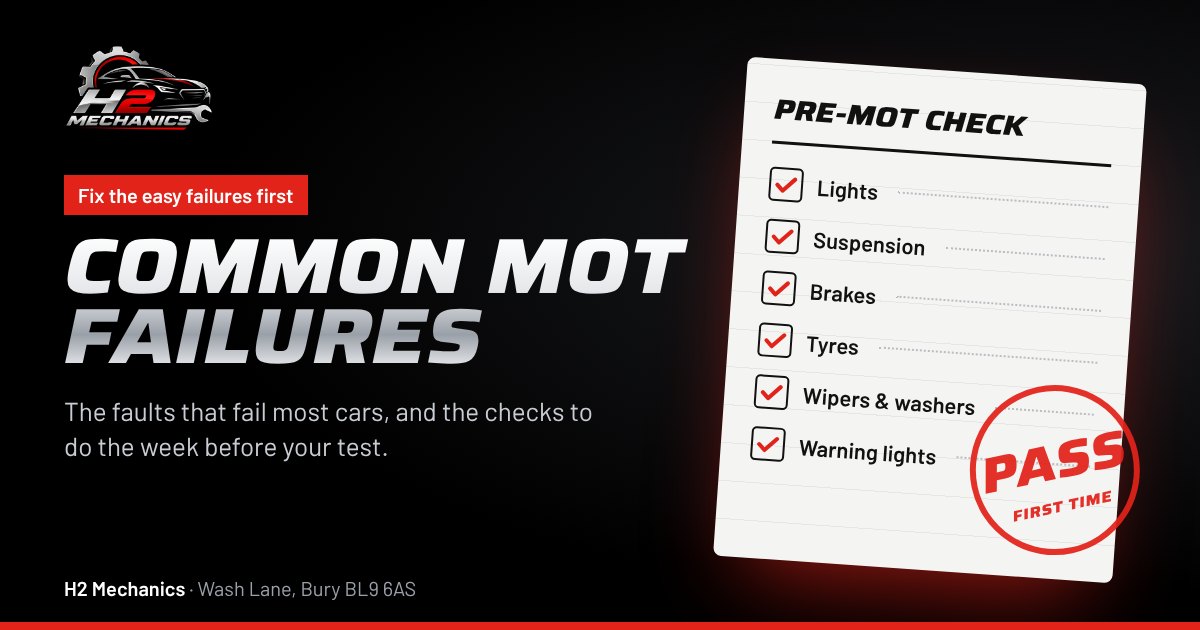
Quick answer: the most common reasons cars fail their MOT are lights and indicators, suspension, brakes, tyres, and the driver's view of the road (wipers, washers and windscreen damage). Many of these are cheap to fix and easy to spot yourself. A 10-minute check at home, or our free car health check, catches most of them before test day.
Failing an MOT is frustrating, especially when the cause is a blown bulb or an empty screenwash bottle. Below are the areas that catch most drivers out, what testers look for, and the simple checks you can do the week before your test.

1. Lights and indicators
Lighting faults are consistently one of the biggest causes of MOT failure, and they're usually the easiest to fix.
- Check every light: headlights (dipped and main beam), sidelights, brake lights, indicators, hazard lights, fog lights, reversing lights and the number plate light.
- Look for cracked or cloudy lenses and lights that are the wrong colour.
- Get someone to press the brake pedal while you check the brake lights, including the high-level one.
2. Suspension
Worn shock absorbers, broken coil springs and worn joints or bushes are common failures, particularly on cars that see a lot of potholes.
- Warning signs: knocking or clunking over bumps, the car sitting lower on one corner, or a bouncy, floaty ride.
- These need a mechanic to inspect properly. See steering and suspension repairs.
3. Brakes
Testers check how well the brakes work, whether they pull to one side, and the condition of pads, discs, pipes and the handbrake.
- Squealing, grinding, a soft pedal or the car pulling when you brake all need looking at before the test.
- Check the handbrake holds the car on a slope.
- A dashboard brake warning light on is a fail. Our brake service covers pads, discs and fluid.
4. Tyres
- Tread must be at least 1.6mm across the central three-quarters of the tyre, all the way round.
- Cuts, bulges and exposed cords are a fail, as are tyres of different sizes or types on the same axle.
- The 20p test is a quick guide: if you can see the outer band of the coin in the grooves, get the tyre checked. More on this in our winter car checklist, or see tyres and wheel alignment.
5. The driver's view of the road
This covers your windscreen, wipers, washers and mirrors, and it catches a surprising number of drivers out.
- Screenwash: an empty washer bottle can fail your MOT. Top it up before the test.
- Wipers: blades must clear the screen properly. Split or smearing blades can fail.
- Windscreen damage: chips or cracks in the area directly in front of the driver can fail if they're bigger than 10mm, and anywhere else the wipers clear if they're bigger than 40mm.
- Remove anything that blocks your view, such as sat nav mounts or air fresheners in the wrong place.
6. Warning lights and emissions
Since the MOT rules changed in 2018, many dashboard warning lights cause an automatic fail, including the engine management light, ABS and airbag lights. Visible smoke from the exhaust of a diesel with a particulate filter can also fail.
- If a warning light is on, book a car diagnostic before the test so we can read the fault code and fix the cause.
- Don't clear the light without fixing the fault. It will usually come back.
7. The small things that still fail
- Horn: it must work and be loud enough.
- Seatbelts: they must lock, retract and be free from cuts and fraying.
- Number plates: they must be clean, readable and in the correct font and spacing.
- Doors and boot: they must open from inside and outside, and close securely.
- Battery: it must be secure, with no leaks. If it's struggling, see battery and electrical repairs.
What your MOT result means
Every item the tester finds is put into one of four categories:

- Dangerous: a fail. The car is a direct risk to road safety and shouldn't be driven until it's repaired.
- Major: a fail. It must be repaired straight away.
- Minor: a pass, but the fault is recorded and should be fixed as soon as possible.
- Advisory: a pass. Something to keep an eye on, as it may need work in future.
How MOTs work at H2 Mechanics
We don't test MOTs ourselves. When you book MOT testing support, we take your car to a nearby independent licensed MOT centre and bring it back. The tester has no reason to fail your car to create repair work. If anything does fail, we explain it in plain English and agree the price with you before doing any repairs.
Want to fix the easy failures first? Book our free car health check the week before your test. We see drivers from Bury and nearby, including Tottington, Whitefield, Bolton and Farnworth.
MOT failures: common questions
What is the most common reason for failing an MOT?
Lights and indicators are consistently among the top reasons, along with suspension, brakes, tyres and problems with the driver's view such as wipers, washers and windscreen damage.
Can an empty screenwash bottle fail an MOT?
Yes. The washers must work during the test, so an empty bottle can lead to a fail. Top it up before you go.
Will my car fail its MOT with the engine warning light on?
For most cars, yes. Since 2018, an illuminated engine management light is a major fault. Get the fault diagnosed and fixed before the test.
How early can I get my MOT done?
You can have your MOT up to a month minus a day before it runs out and still keep the same renewal date. Your current expiry date is on your last MOT certificate, or you can check it on GOV.UK.
Can I drive my car if it fails its MOT?
Not if it has a dangerous fault. If your old MOT certificate is still valid and there are no dangerous faults, you can drive it, but it must still be roadworthy and you should get the repairs done straight away.
Need a hand with your car?