
Dashboard warning lights: which ones mean stop now?
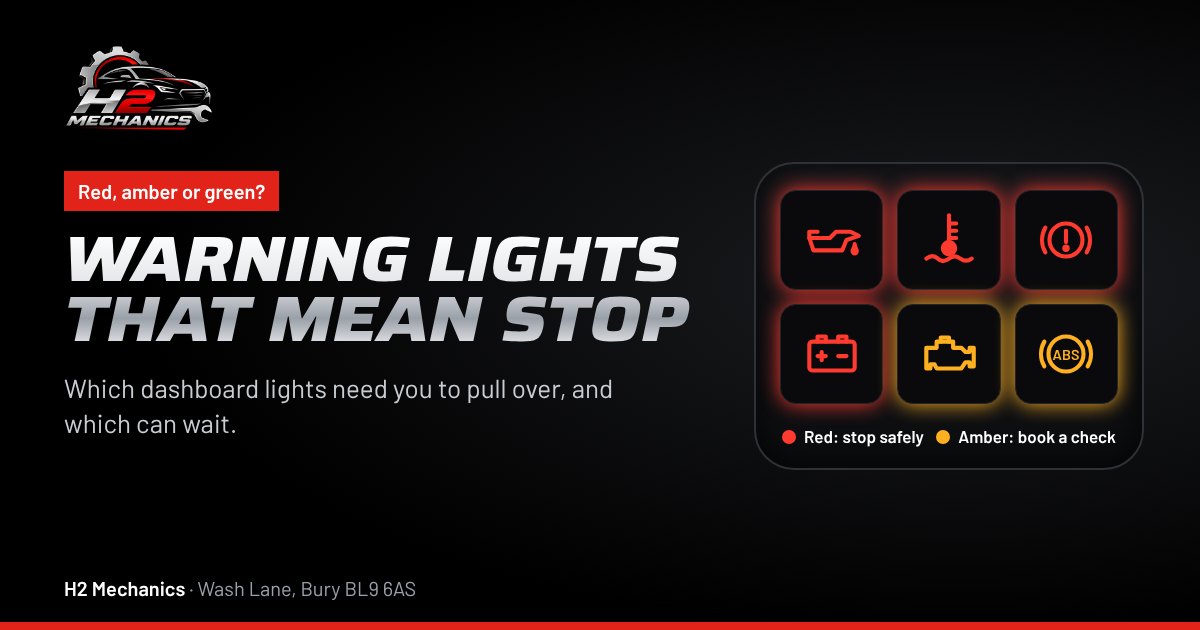
Quick answer: red dashboard warning lights mean stop as soon as it's safe, especially the oil pressure, engine temperature and brake system lights, because driving on can cause serious damage or make the car unsafe. Amber lights mean something needs checking soon, but you can usually drive carefully to a garage. A flashing engine management light is the exception: ease off and get it checked the same day.
Modern cars have dozens of warning lights, and it's not always obvious which ones are urgent. This guide covers the colour system, the lights that mean stop now, and the ones that can wait for a booked appointment.

What the colours mean
Most manufacturers use a traffic-light system, though symbols and colours vary between makes, so check your handbook for your car.
- Red: a serious problem or a safety risk. Stop when it's safe to do so and find out what's wrong before driving on.
- Amber or yellow: a fault or a reminder that needs attention soon. Drive carefully and get it checked.
- Green or blue: information only, such as headlights, main beam or cruise control being on.
It's normal for many lights to come on briefly when you switch on the ignition. That's the car checking its bulbs. The concern is a light that stays on once the engine is running, or one that comes on while you're driving.
Red lights that mean stop now
- Oil pressure (an oil can): the engine has lost oil pressure. Without it, internal parts can be damaged within minutes. Stop safely, switch off the engine and check the oil level. Even if the level looks fine, don't drive on until it's been checked.
- Engine temperature (a thermometer in waves): the engine is overheating. Stop, switch off and let it cool. Never open the coolant cap while the engine is hot, as the coolant is under pressure.
- Brake system (an exclamation mark in a circle): first make sure the handbrake is fully off. If the light stays on, it can mean low brake fluid or a fault in the brake system. Don't drive on; arrange for the car to be checked.
Red lights that need action today
- Charging system (a battery symbol): the battery isn't being charged, often because of an alternator or drive belt problem. The car will keep running on battery power until it runs flat. Turn off anything you don't need and drive straight to a garage rather than stopping and restarting.
- Airbag (a seated figure with a circle): the airbag system has a fault and may not work in a crash. The car is drivable, but get it checked promptly.
- Power steering (a steering wheel, sometimes with an exclamation mark): the steering may suddenly feel much heavier. Drive carefully to a garage.
Amber lights to get checked soon
- Engine management (an engine outline): a steady light means the engine's computer has spotted a fault, which could be anything from a sensor to an emissions problem. A flashing light usually means a misfire, which can damage the catalytic converter, so reduce speed and get it checked the same day.
- ABS (the letters ABS in a circle): the anti-lock system has a fault. Your normal brakes still work, but the wheels could lock under hard braking, so leave extra space.
- Tyre pressure (a horseshoe shape with an exclamation mark): one or more tyres has lost pressure. Check and inflate them, and look for punctures.
- Diesel particulate filter (a box with dots): the filter is getting blocked, often from lots of short trips. Your handbook will explain whether a longer drive at steady speed can help.
- Glow plug (a coil, on diesels): normal briefly at start-up, but if it flashes or stays on while driving, there's a fault to check.
Warning lights and your MOT
Several warning lights, including the engine management, ABS, airbag and brake warning lights, are checked during the MOT. A warning light showing a fault can lead to a failure, so it's worth getting it sorted before your test. Our guide to the most common MOT failures covers other things to check.
How we can help
A warning light is the car telling you it has logged a fault. A car diagnostic (£100) reads the fault codes and, more importantly, tracks down the cause, so you're not paying to replace parts on a guess. If the brake light is the issue, our brake service starts from £80.
A battery light often points to the charging system rather than the battery itself, and our battery and electrical service tests both. If you're not sure the car is safe to drive, call us on 07385 295931 before setting off. Either way, we tell you what's wrong and the price before any work starts. If the battery has been struggling too, read why car batteries die in cold weather.
We see drivers from across Bury and further afield, including Bolton and Farnworth.
Dashboard warning lights: common questions
Which dashboard warning lights mean I should stop driving?
Red lights for oil pressure, engine temperature and the brake system mean stop as soon as it's safe. Driving on can cause serious engine damage or affect your brakes.
Can I drive with the engine management light on?
If it's steady and the car feels normal, you can usually drive carefully to a garage, but get it checked soon. If it's flashing, reduce speed and get it checked the same day, as it often means a misfire.
Why do all the warning lights come on when I start the car?
That's a normal bulb check when you switch on the ignition. The lights should go out within a few seconds of the engine starting.
Will a warning light fail the MOT?
It can. Warning lights for systems like the engine, ABS, airbags and brakes are checked during the MOT, and a light showing a fault may lead to a failure.
Does clearing the fault code fix the problem?
No. Clearing a code only turns the light off. If the fault is still there, the light will usually come back, so the cause needs finding and fixing.
Need a hand with your car?